


How to choose technical fluids based on tolerances and compatibility to reduce the risk of failure
In short, choosing the right technical fluids means adhering to manufacturer specifications and avoiding haphazard mixing of types. This directly reduces the risk of corrosion, pump seizure, and loss of brake effectiveness. For a systematic approach, I recommend starting with a detailed resource on choosing technical fluids , which includes antifreeze compatibility tables and interval charts. In this article, I’ll discuss specific rules for antifreeze, ATF, brake fluid, and power steering fluid: what to look for in the labeling, the consequences of errors, and practical steps to take.
Why Tolerances Are More Important Than Color “Similarity”
The color of antifreeze or ATF doesn’t guarantee anything: red, green, or blue are just marketing gimmicks and service convenience, but the materials used in the concentrates and inhibitors determine how they behave in the system. Tolerances (OEM specifications and industry standards) describe the composition, corrosion protection, boiling/freezing points, and seal compatibility. Ignoring these tolerances leads to accelerated radiator corrosion, sludge formation, and clogging of delicate heating channels.
Antifreeze: types, markings and compatibility
Antifreezes are classified by inhibitor base: inorganic (IAT), organic (OAT), and hybrid (HOAT/Si-OAT). Each type is designed for a specific metal base and seal material.
Rules of thumb:
- Do not mix IAT and OAT – this will accelerate sludge formation and reduce the effectiveness of corrosion protection.
- When choosing, look at the OEM approval (for example, VW G12, Ford WSS-M97B44-D) – this is more important than the color.
- If you change the type, flush the system and completely replace the concentrate, otherwise the new inhibitors will be neutralized by the old ones.
The consequences of incorrect mixing include sludge in heating furnaces, and broken gaskets and thermostats, which are far more expensive than simply pouring in the wrong fluid.
How to check before buying: Compare the composition in the tolerance table and make sure that the manufacturer specifies the shelf life and concentration (usually 50% ethylene glycol/propylene glycol).
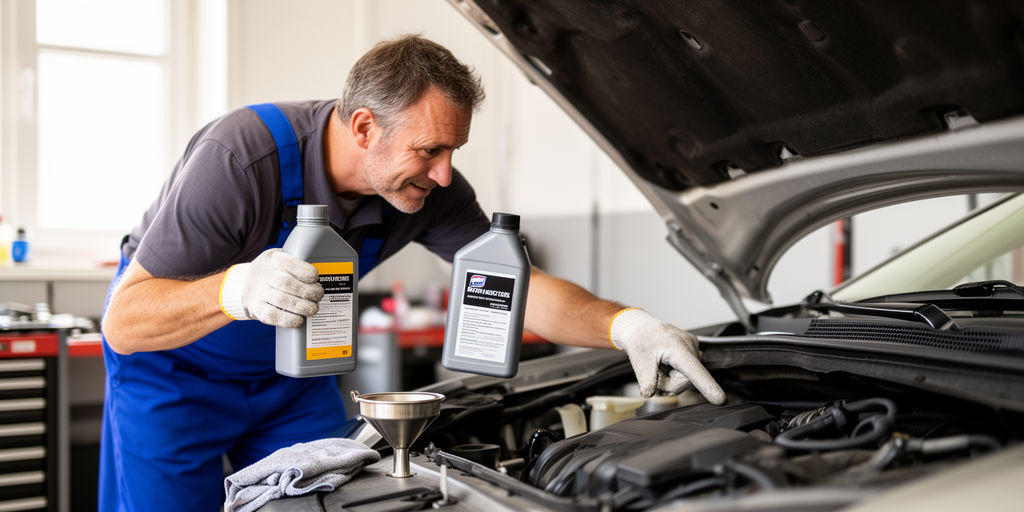
ATF (transmission fluids): specifications and risks
ATF covers a wide range of standards: Dexron/Mercon for automatic transmissions, JASO/GL for manual transmissions, and specialized synthetic formulas for robotic and DSG transmissions. Incorrect ATF can cause improper clutch pack friction, slippage, and rapid torque converter wear.
- Always refer to the transmission tolerance (in the manual or on the service plate).
- If the box states Dexron VI, you cannot fill it with old Dexron III or another branded transmission fluid that does not meet the approval.
- Replacement interval: for many modern automatic transmissions – from 60 to 120 thousand km, but for severe conditions (towing, city driving) it is better to reduce the intervals by half.
Brake Fluid: DOT Classes and Replacement Guidelines
Brake fluid is hygroscopic, absorbing moisture and losing its boiling point. DOT standards (3, 4, 5.1, 5) differ in composition and boiling point; DOT 5 is silicone-based and incompatible with glycol-based DOT 3/4/5.1.
- Do not mix DOT 5 with glycol fluids, as this will cause delamination and loss of functionality of the brake circuit.
- Check the boiling point and moisture content during diagnostics; if the circuit overheats, wet fluid will cause a “boiling” pedal.
- Recommended replacement interval: Every 1–2 years depending on moisture content measurements.
Power steering: mineral vs. synthetic
Power steering fluids vary by base: mineral, synthetic polyalphaolefin (PAO), and special ATF-based fluids. Pumps are sensitive to viscosity and additive composition; the wrong fluid reduces the lifespan of hoses and seals, causes noise, and pressure drops.
Always use the type specified in the manual: manufacturers often specify a specific brand or approval. When switching from one type to another, cleaning and replacing the seals is mandatory.
How to read tolerances and where to find them
Tolerances are found in the owner’s manual, on the reservoir cap, or in the engine and transmission manufacturer’s technical documentation. OEM tolerances are not recommendations, but specifications for a specific design and materials.
If the approval is not stated directly, look for equivalents from chemical manufacturers and in the approvals catalog: they provide compatibility tables and application limits.
Step-by-step instructions for purchasing and replacing
- Identify the system (cooling, transmission, brakes, power steering) and find the OEM approval.
- Check the tolerance of the selected fluid according to the manufacturer’s marking.
- If you change the type, flush the system and replace filters/seals if necessary.
- When filling, observe the concentration (antifreeze) and volumes specified in the manual.
- Keep a log of replacements – this will reduce the risk of missing an interval.
Storage, mixing, and little life hacks
Store fluids in tightly sealed containers and protect them from water: moisture is critical for brake fluid. Do not mix residues from different brands unless the specifications match. When purchasing, choose factory-sealed canisters—there are many “diluted” examples on the market.
Conclusion – what to take into practice
The main rule: trust tolerances, not color or marketing hype. For each system, find and record the required tolerance, adhere to replacement intervals, and don’t experiment with mixing types. These are simple measures, but they reduce the likelihood of serious failure and reduce long-term operating costs.
If you want to quickly check antifreeze compatibility and replacement intervals, start with a verified tolerance table and specific recommendations from your vehicle manufacturer: this will help make your selection clear and safe.

Virtual Private Server Hosting for High-Security Business Applications


